
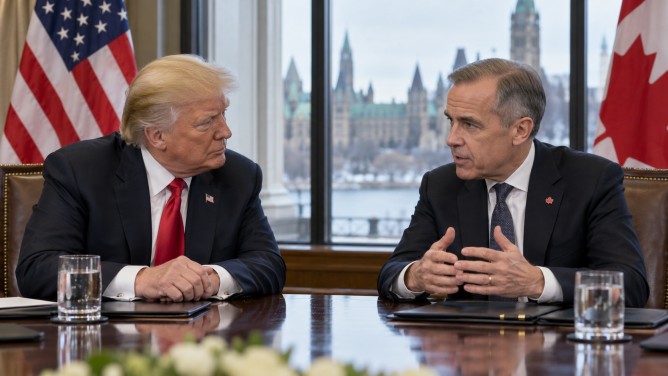
The United States and Canada are working towards a potential trade agreement following discussions between U.S. President Donald Trump and Canadian Prime Minister Mark Carney. Both leaders have shown optimism about the negotiations, with Trump stating that his administration has developed a preliminary concept for the deal.
In a conversation with reporters in Iowa, Trump revealed that he had recently spoken with Carney regarding trade relations. He expressed that the proposed agreement would be advantageous for American farmers and the broader U.S. economy. Additionally, Trump indicated that the deal might include the construction of the Keystone XL pipeline, a controversial project that was previously halted under former President Joe Biden.
Carney echoed a positive outlook on his recent dialogue with Trump, highlighting that their discussions had built upon previous constructive exchanges aiming to establish a mutually beneficial trade agreement. He mentioned that officials from both nations would continue working over the next few weeks to advance the negotiations.
Trade relations between Washington and Ottawa have been under strain since Trump returned to office and imposed tariffs on several Canadian products. Negotiations collapsed in August, leading to additional tariffs that impacted approximately $20 billion worth of goods, such as cement and hockey equipment. In response, Canada introduced retaliatory tariffs on American products, which led to further trade restrictions from Washington. Although some U.S. tariffs on Canadian goods have been eased, trade tensions continue to affect businesses and economic relations between the two countries.
In the meantime, Canada has been seeking to diversify its international trade partnerships. Its recent agreement with the European Union to establish a closer economic partnership exemplifies Ottawa’s efforts to strengthen trade ties beyond the United States. The proposed U.S.-Canada agreement could help reduce economic uncertainty, improve cross-border trade, and bolster relations between the two major trading partners.