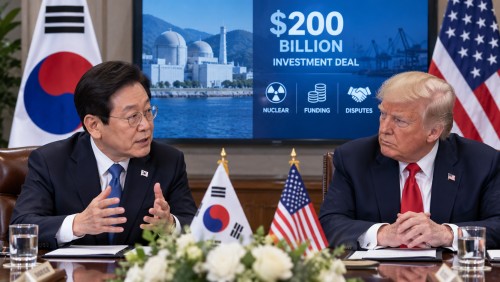
South Korea and the United States are facing significant challenges in reaching an agreement on Seoul’s ambitious $200 billion investment in U.S. projects, primarily due to disagreements over nuclear power ventures and financial arrangements. The ongoing negotiations have yet to resolve key issues surrounding nuclear reactor design choices and the timeline for South Korea’s funding contributions.
The two nations have been discussing the construction of eight nuclear reactors in the United States, with a mix of technologies involving Westinghouse’s AP1000 and South Korea’s APR1400 designs. However, U.S. officials and Westinghouse have expressed opposition to incorporating the APR1400 technology, complicating the finalization of the nuclear component of the investment package. South Korea has indicated that approximately $120 billion of its pledged investment could be directed toward nuclear-related projects.
Another point of contention is South Korea’s potential acquisition of a stake in Westinghouse. Seoul is reportedly interested in securing a 15% to 20% ownership along with voting rights and a board seat, while Westinghouse aims to limit this stake to under 10%. Additionally, discussions are underway regarding South Korea’s involvement in a U.S. project for processing spent nuclear fuel, as well as a proposed liquefied natural gas project in Alaska.
Financial disagreements have further clouded the negotiations, particularly concerning the schedule of South Korea’s financial contributions. While Washington has called for more than $9 billion by the end of the year, South Korea had initially planned to start with smaller amounts in 2026, ramping up investment from 2027 onward. There is also discord over how investment returns and losses should be calculated, with South Korea advocating for a model where profits from successful projects offset losses from others, contrary to the U.S. preference for separate accounting per project.
Under the proposed framework, the U.S. would receive 90% of net profits after the recovery of principal and interest, a point that has raised concerns in Seoul over potential imbalances in profit distribution. Despite these unresolved issues, both governments remain engaged in negotiations, with South Korea’s Industry Ministry emphasizing that no final decisions have been made regarding the investment details.