
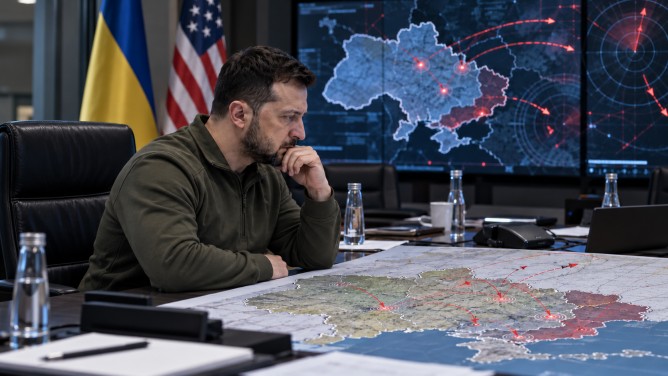
The United States has resumed intelligence sharing with Ukraine regarding Russian missile strikes, as confirmed by Ukrainian President Volodymyr Zelenskyy. Following discussions with U.S. envoy Steve Witkoff in Norway, Zelenskyy announced that this renewed cooperation will allow Ukraine to receive advance warnings of ballistic missile attacks, which is crucial for protecting civilians.
Zelenskyy expressed his gratitude to the United States, emphasizing that early warnings are vital for the safety of children and adults amid ongoing Russian attacks. The intelligence sharing is seen as a significant step in bolstering Ukraine’s defense capabilities, although it comes at a time when relations between Washington and Kyiv are strained over future military support and the pursuit of a resolution to the Russia-Ukraine conflict.
During the talks, Zelenskyy also addressed concerns about restrictions on Ukraine’s military communications and the availability of Patriot air defense interceptors. He indicated that Ukraine might consider stopping long-range attacks on Russian oil refineries if the U.S. provides additional Patriot missiles, which would enhance Ukraine’s air defense systems.
In the broader context, U.S. President Donald Trump has been urging Zelenskyy to negotiate a peace agreement, but Ukraine maintains that any settlement must respect its sovereignty and involve its direct participation. After meeting with Zelenskyy, Witkoff was scheduled to engage with Russian President Vladimir Putin to explore potential pathways towards negotiations, although significant disagreements persist over the terms of a potential peace settlement.
Meanwhile, the conflict continues to inflict casualties in Ukraine. On Tuesday, at least nine people were reported killed, including three who died when a Russian drone struck vehicles on the Kyiv-Odesa highway. The attacks underline the urgency and importance of the resumed intelligence-sharing agreement.
The resumption of intelligence sharing is expected to enhance Ukraine’s preparedness against missile threats, yet uncertainties remain regarding the extent of future U.S. military assistance and the feasibility of achieving a negotiated end to the ongoing conflict.