
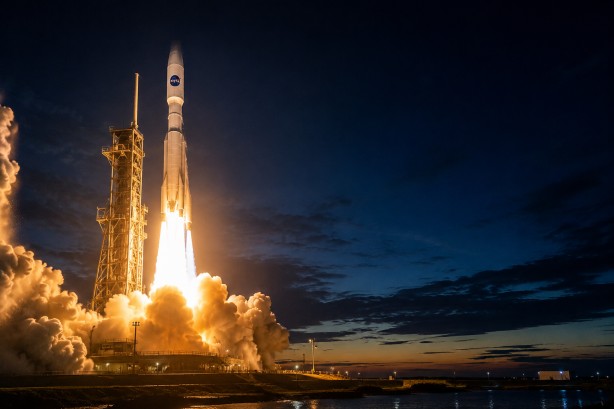
The Nancy Grace Roman Space Telescope has embarked on its mission after a successful launch from Florida. This $4.3 billion NASA project aims to investigate exoplanets, the formation of planets and galaxies, and some of the universe’s greatest mysteries. After nearly a decade in development, the telescope took off from NASA’s Kennedy Space Center on a SpaceX Falcon Heavy rocket, marking a new era in space exploration.
Roman is set to complement the existing capabilities of the Hubble and James Webb Space Telescopes. Equipped with a powerful 300-megapixel infrared camera, it will produce images with a resolution similar to Hubble but will cover an area in the sky 100 times larger. Each snapshot will encompass an expanse about 1.5 times the apparent size of the full Moon. A key feature of Roman is its coronagraph, which can block out the glare of stars, enabling scientists to study nearby planets in more detail, including older and colder planets orbiting close to their stars.
Positioned at the Sun-Earth Lagrange Point 2, the same stable location as the James Webb Space Telescope, Roman will perform a variety of observations over its five-year primary mission, which has the potential for extension. Scientists anticipate that Roman’s observations will shed light on dark matter, dark energy, distant galaxies, supernovae, black holes, and exoplanets. Its wide-field survey capabilities also promise to uncover new targets for further examination by Hubble and Webb.
Following its launch, the telescope is expected to deliver its first scientific images by early 2027, contingent on successful testing and calibration. In keeping with NASA’s commitment to open data, these images will be made available to both researchers and the general public, providing a vast resource for professional and amateur astronomers alike. The mission’s successful initiation is especially significant given its history of proposed budget cuts, as previous White House plans sought to cancel the project before Congress opted to maintain its funding.
The launch of Roman marks a pivotal moment in NASA’s quest to decode the mysteries of the universe, from the expansion of the cosmos to the formation of planets over billions of years. The advancements it offers are poised to enhance our understanding of the universe, offering a new chapter in space exploration and discovery.