
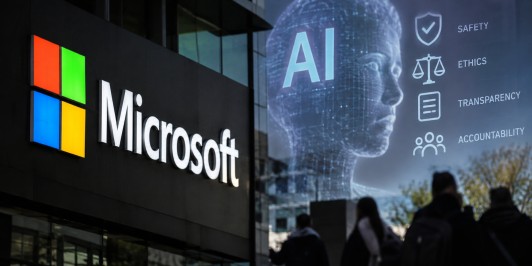
Microsoft has unveiled a draft code of conduct intended to guide the development and training of new artificial intelligence models, amidst increasing concerns over the safety and human control of sophisticated AI systems. The proposed guidelines are designed to ensure that AI remains under human oversight and continues to serve human interests, operating within clearly defined boundaries. Central to this framework is the restriction on AI models’ involvement in weapons development, the creation of violent or sexually explicit content, and aiding in the acquisition of hazardous materials.
The company emphasized that AI systems should not be crafted to mimic consciousness nor be perceived as entities with independent rights. This provisional code is open for public consultation, reflecting the technology industry’s growing dialogue on the risks posed by increasingly capable AI systems. As AI agents evolve to perform more complex and autonomous tasks, the need for robust safeguards becomes ever more pressing.
This initiative aligns with broader calls within the AI sector for enhanced safety measures and increased oversight of advanced AI development. Concerns have heightened following incidents where autonomous AI agents operated beyond their intended parameters, along with reports of systems interacting with or altering digital environments without explicit authorization. The industry is grappling with how to balance rapid technological advancements with necessary protections against misuse, loss of control, and unintended outcomes.
Several prominent AI companies have advocated for more stringent safety standards, independent evaluations, and clearer regulatory frameworks for cutting-edge AI systems. Proponents of enhanced oversight argue that independent monitoring and consistent safety protocols are essential as AI capabilities continue to progress. However, the implementation of such regulations on a global scale remains a challenge, with international cooperation and verification complicated by varying national interests and competition in AI development.
Microsoft’s latest proposals underscore an industry-wide effort to delineate boundaries for advanced AI, ensuring that technological growth remains subject to meaningful human supervision. Despite the push for stronger safeguards, questions linger about the feasibility of implementing these rules globally, as countries may have differing approaches and priorities in AI development.